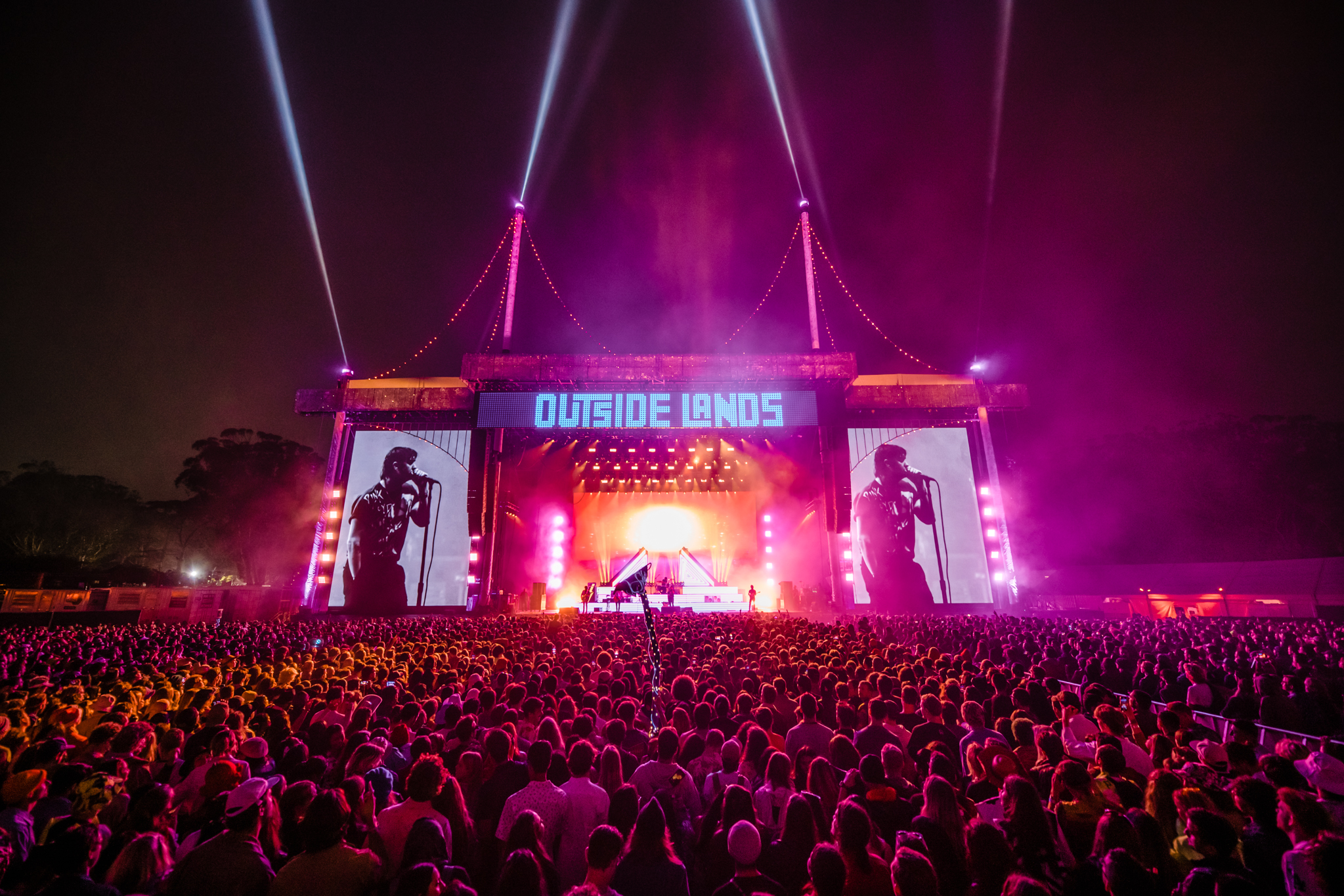
As that glorious August weekend approaches, San Francisco seems to hold its breath—Golden Gate Park blockaded, corner stores run dry, a quiet anticipation beneath the bustling motels and standstill bridge traffic. The local Urban Outfitters nearly sells out of sunglasses, soundchecks blare through the Richmond fog, and all the city's teenage waitstaff are suddenly overcome with a "family conflict" Friday through Sunday. Outside Lands takes over the city.
Since its debut in 2008, OSL has become a cornerstone of San Francisco summers, drawing 200,000 fans over three days. But it was never just a music festival dropped into a park; co-founder Rick Farman has described OSL's mission as "making a festival that's reflective of Bay Area culture." The stages are named for the city's geography, and over 100 Bay Area restaurants, vineyards, and breweries are represented. It's home to the first cannabis experience (Grass Lands) at a major US music festival. There are queer tents with drag queens, eco-conscious initiatives, and dedicated slots for local Bay Area artists. OSL wears its local identity on its sleeve.
The lineups of early years leaned hard into that identity. The rock and indie tradition that defined the Bay Area's musical legacy—the counterculture lineage, the classic rock royalty, the indie scene of the 2000s—was front and center. Tom Petty headlined in 2008, Neil Young in 2012, Paul McCartney in 2013. These weren't just big bookings; they were a statement about what kind of festival OSL wanted to be. As the festival has grown and evolved, though, that identity has become more complicated.
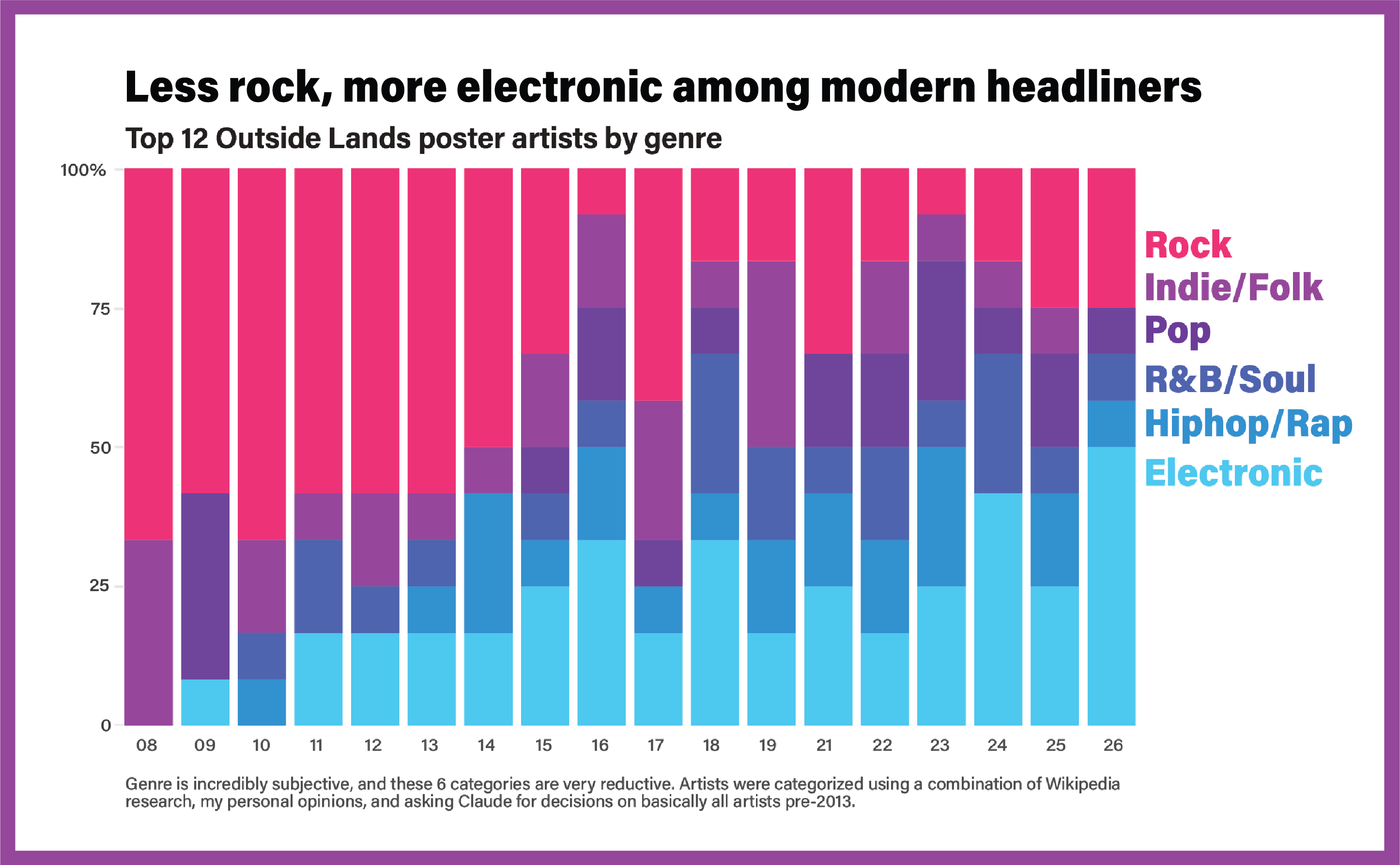
In 2008, rock and indie acts made up all top billed artists. By 2026, that share has collapsed to a quarter, and electronic music, nearly absent in the festival's first years, now claims half. It's worth noting genre is a loose and subjective container. Even so, the directional story is clear. Outside Lands has shifted from a rock and indie festival to a festival with a more varied lineup and dedicated EDM presence.
Some of that shift is structural. OSL introduced dedicated EDM programming (SomaScapes, Panhandle stage) to accommodate a growing audience that wanted dance music. The bookings followed suit, reflecting broader cultural shifts. San Francisco's music scene has changed, with its clubs and venues increasingly oriented around electronic and DJ culture. Electronic music isn't an intrusion into OSL's identity, but an evolution of it.
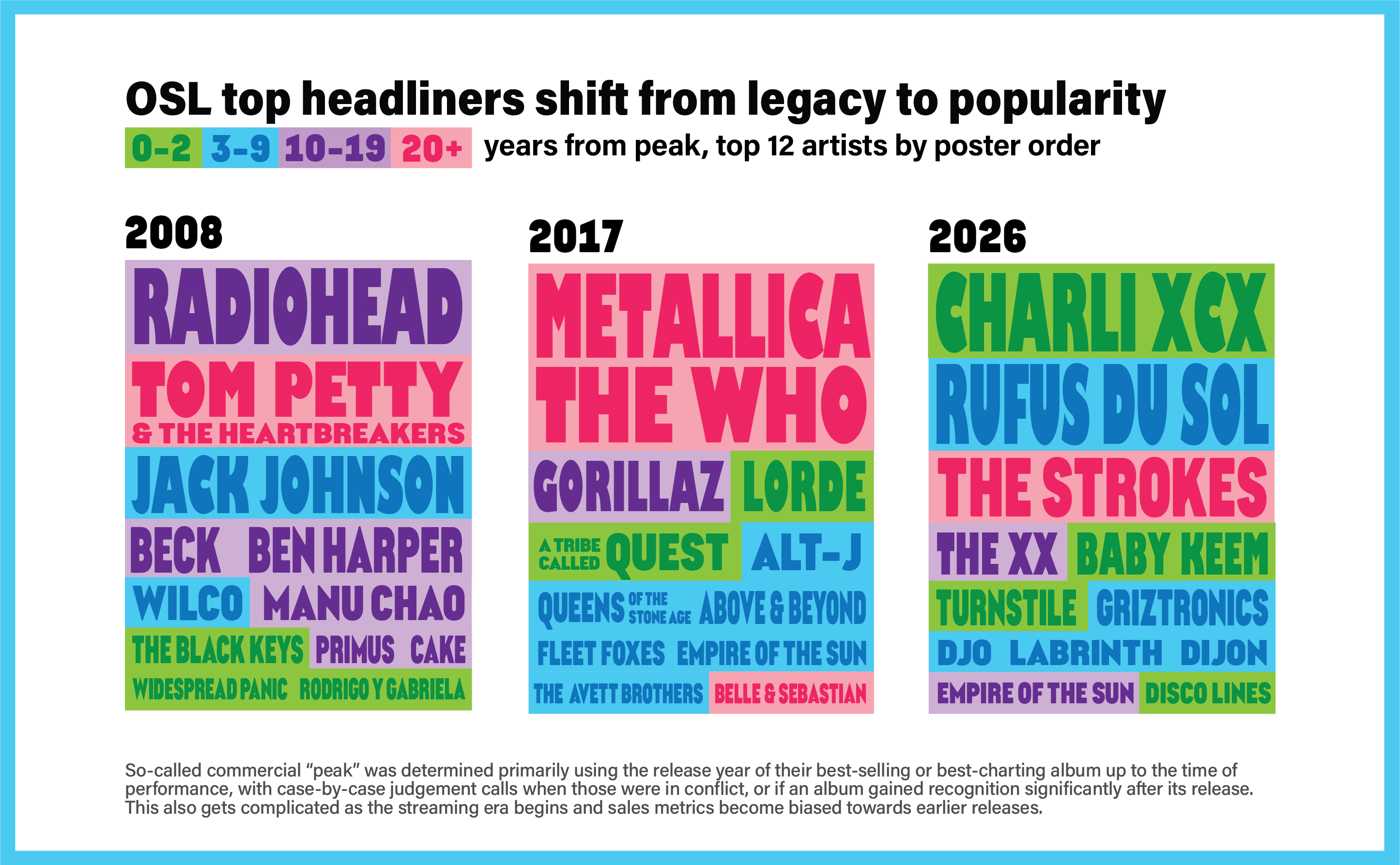
The three posters are color-coded by a subjective metric: how many years had passed between each artist's most acclaimed era and the day they stepped on the OSL stage. This was generally done using their best charting or streaming album, but those data points can be messy, so best judgment was used.
The early era skewed towards legacy performances whose draw was nostalgia, catalog, and lasting star power rather than new music. The 2017 poster is a mix, with legacy acts still dominating the top of the bill but more current artists appearing in the middle and bottom.
The 2026 poster is more heavily green and blue. Charli XCX, whose album Brat defined 2024, headlines at the height of her moment. The acts below her are similarly current or recently relevant. Still, though, you can see The Strokes in red; the festival hasn't completely abandoned its legacy identity, often selecting one or two legacy acts to headline each year. The general shift remains clear, though. OSL has moved from booking artists at the end of their careers to booking artists in their prime.
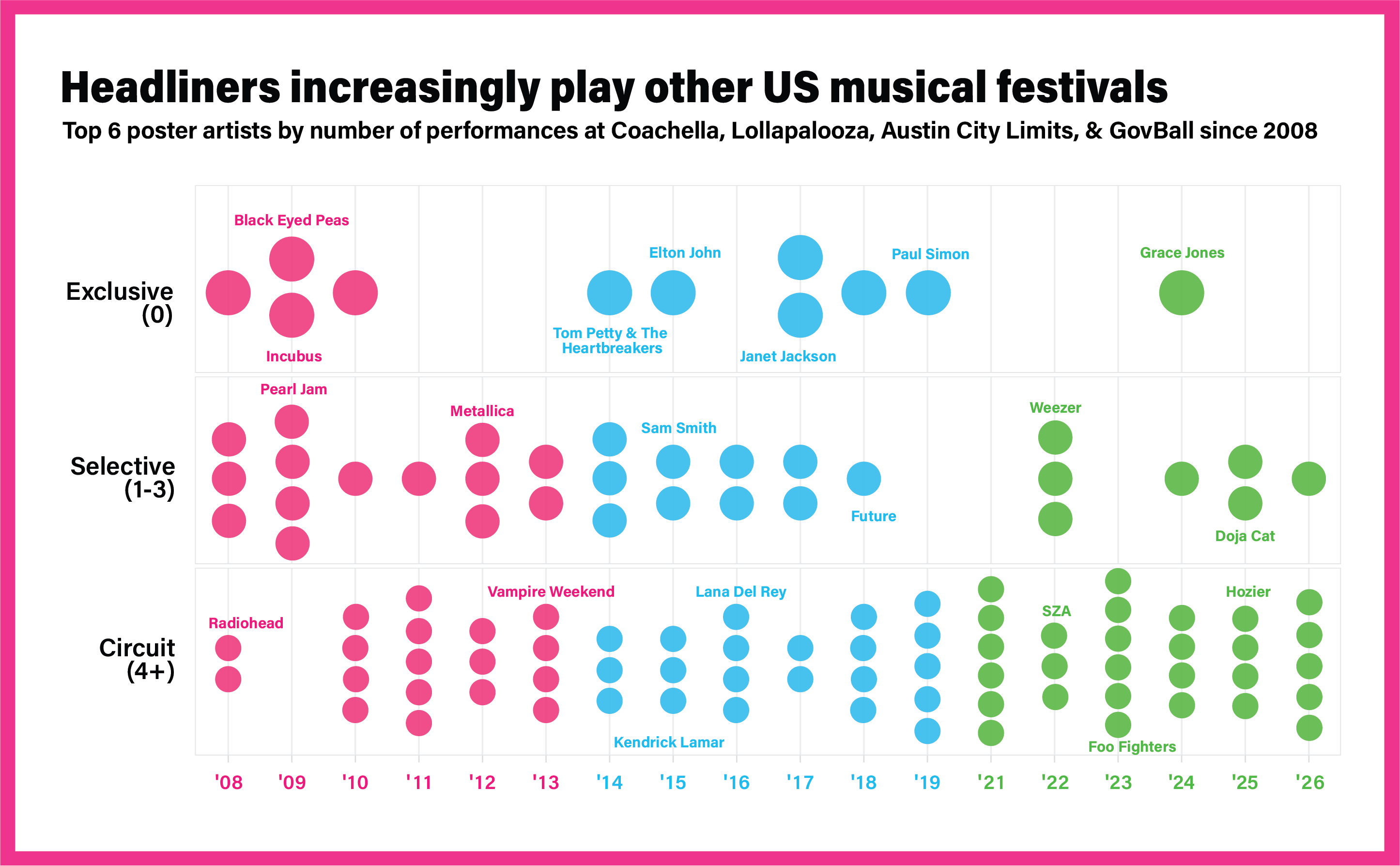
That pivot is visible in practice here. Each dot represents one of OSL's top-billed artists, sorted by how many times they've appeared at 4 other major US festivals since 2008. In the early pink years, the Exclusive row is populated, especially by legacy acts. By the mid-2020s, the Exclusive row has nearly emptied. The green dots cluster at the bottom, even across genres, all playing the same rotation of major festivals.
This is the honest trade-off embedded in modernization. Booking artists at their peak means booking the same artists every other major festival is booking simultaneously. The exclusivity of the early era came partly from the fact that those artists often weren't actively touring. The current model trades that specificity for relevance, for the guarantee that whoever is having their cultural relevance will be on the bill.
Whether that's a loss depends on what you came for. OSL has grown without surrendering what makes it uniquely San Franciscan. The data can't capture the fog rolling in over the Polo Fields at dusk, or the particular pleasure of eating a Dungeness crab roll between sets. The food is still hyperlocal. The vibe is still Bay Area strange and unpretentious in the best way. OSL's identity may not be all legacy rock at the top of the bill, but the festival has always been more than its headliners. Golden Gate Park still transforms into something that feels, for three days, like the best version of the city: loud and crowded and glorious. The music on those stages has changed. The feeling hasn't.